
Table of Contents
Studying with ADHD isn't just a focus problem. It's an executive function problem. Time blindness, working memory gaps, difficulty starting tasks, and emotional dysregulation all get in the way before you've opened a single book.
The right tools don't fix those things. They reduce the friction around them, enough to make the difference between a productive session and an hour of staring at your desk.
Here are five worth knowing about.
- Time-blocking for a brain that loses track of time
Unstructured time is one of the hardest things for an ADHD brain to manage. Without clear boundaries around when something starts and ends, time expands and contracts unpredictably. An hour disappears. A ten-minute task takes three.
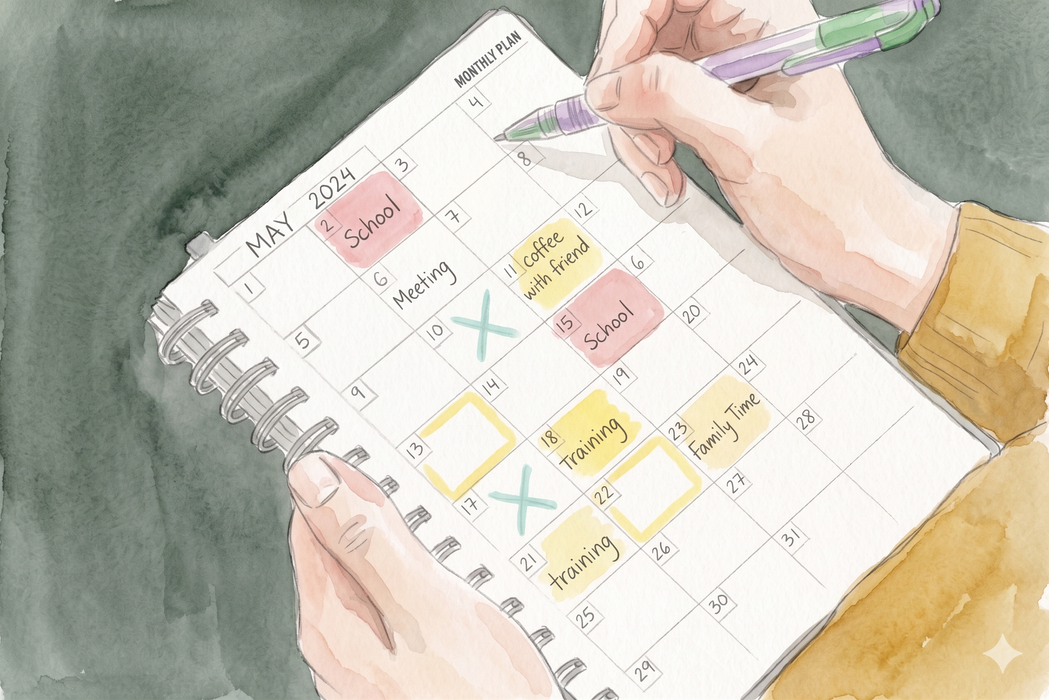
Time blocking assigns specific activities to specific windows in your day. It makes time visible rather than abstract. You're not deciding what to do next; the decision is already made.
Time blocking can be really structured, with a specific task allocated to a time block. That can work for some people, but typically neurodivergent brains work better with flexible time blocks. This is when time is allocated to an activity - admin tasks, resting, deep-thinking etc., rather than specific tasks. The aim is to then do as much of that activity as you can in the time allocated.
- Flashcards for short-burst, high-return revision
Long revision sessions are a poor fit for ADHD. Attention fades, the return on time spent drops sharply, and the effort of sustaining focus becomes the main event rather than the learning itself.
Flashcards work because they match how ADHD attention actually functions. Each card is a discrete unit: a prompt, a response, a result. Your brain gets a clear signal that something happened. Then it moves on to the next one.
 Tim Jones
Spaced repetition makes this more effective still. Rather than reviewing everything every session, spaced repetition surfaces cards at the point when you're about to forget them, concentrating your effort where it's most needed. Luna is built on this principle. Sessions are short, progress is visible, and the app decides what you review and when.
- Focus timers that make work feel finite
One of the reasons starting is hard with ADHD is that open-ended tasks feel boundless. If you sit down to "do some revision," there's no clear end point, which makes beginning feel heavier than it should.
A focus timer solves this by making the work finite. The Pomodoro Technique structures study into 25-minute blocks followed by a 5-minute break. You're not studying until it's done. You're studying until the timer goes off.
Apps like Forest and Focus Keeper can help run this structure for you. The break is built in, which removes the guilt around stopping, and the fixed end point makes starting easier. For ADHD brains that struggle with task initiation, knowing exactly when something will end changes the calculation.
- Sound tools for a brain that notices everything
Auditory distraction is a significant drain for many ADHD learners. A conversation in the next room, music with lyrics, unpredictable background noise: all of these compete for attention that's already difficult to direct.
Noise-cancelling headphones remove the unpredictability. You control the sensory environment rather than being at the mercy of it. Ambient sound apps like Noisli and Endel go further, generating consistent background sound (rain, white noise, low-frequency tones) that masks distraction without becoming a distraction itself.
The goal is a sensory environment that asks nothing of you. When your surroundings are stable and predictable, your attention has one fewer thing to manage.
- Platforms built for the way your brain works
General productivity tools are designed for neurotypical users. They assume you can prioritise a list, estimate how long things will take, and transition between tasks without difficulty. For ADHD learners, those assumptions break down at almost every point.
The tools that work best for ADHD aren't the ones that demand the most discipline. They're the ones that reduce the number of decisions you have to make before you can start. Structure, short sessions, sensory control, and visible progress: these are the conditions your brain works best in. The right tools put those conditions in place so you don't have to rebuild them from scratch every time you sit down.